

Battery C-Rate Explained: A Friendly Guide to Charging, Discharging, and Lifespan
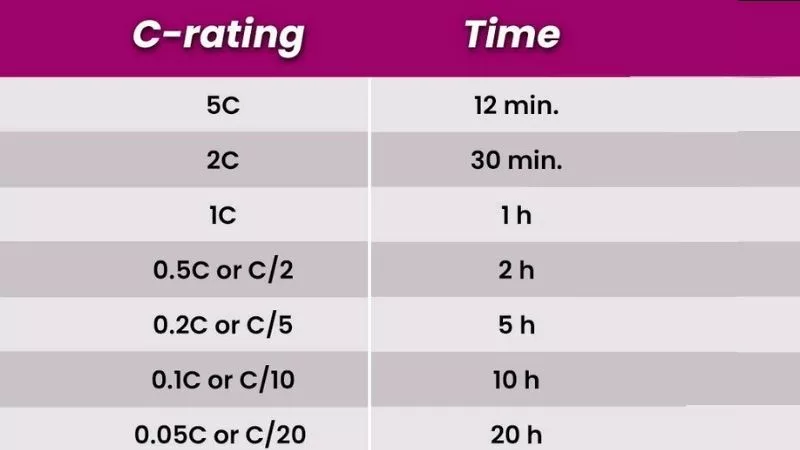
Battery C-rate tells you how quickly a battery can safely charge or discharge relative to its capacity — a 1C battery delivers its full capacity in one hour, 2C does it in 30 minutes, and 0.5C takes two hours.
In this guide, we’ll break down what the C-rating means, how to spot it on a battery label, why it’s crucial for performance and safety, and how to calculate exactly what you need.
What Does The Battery C-Rate Mean?
The battery’s C rating defines the speed of its energy flow. It’s calculated by dividing the charge or discharge current (in Amps) by the battery’s total capacity (in Amp-hours, or Ah). The formula is: C-rate = Current (A) / Capacity (Ah).
For a 100 Ah battery, a 1C discharge rate means a 100 Amp current, which would fully discharged the battery in one-hour. A 0.2C rate would be a gentler, slow discharge rate of 20 Amps, taking 5 hours.
Quick C-rate Reference:
| C-Rate | Time for Full Discharge | Typical Use Case |
|---|---|---|
| 0.1C-0.5C | 10-2 hours | Solar storage, backup power |
| 1C | 1 hour | Standard charging, many consumer devices |
| 5C-10C | 12-6 minutes | Power tools, e-bikes |
| 20C+ | 3 minutes or less | Drones, RC vehicles, high-performance applications |
Remember: Always check the manufacturer’s specific ratings. What one battery handles easily at 10C might damage another with the same nominal rating.
How Is The C-Rating Of A Battery Represented?
A battery’s C rating appears in a few standard ways, from simple labels to detailed specs. On a battery label, you’ll often see it as part of a compact code (e.g., 3S 2200mAh 45C). Here, 2200mAh (or 2.2 Ah) is the capacity, and 45C is the advertised maximum discharge C-rate.
Crucially, most batteries have two ratings:
- Continuous C-Rate: The steady current (e.g., 20C) the rechargeable battery can deliver safely over a long period.
- Peak (Pulse) C-Rate: The higher, short-burst current (e.g., 45C for 10 seconds) it can handle momentarily, crucial for acceleration.
Always check the datasheet to see both numbers. Relying only on the big “45C” on the sticker can be misleading, as the sustainable continuous rate is often lower. Safe charge and discharge rates also depend on battery chemistries (like Lithium Iron Phosphate vs. standard Li-ion), which have different tolerances.
Why Is The Battery C-Rate Important?
The C-rating is crucial because it sits at the intersection of Performance, Safety, and Battery Life.
Performance: Enabling Devices to Operate
The right high C-rate allows your power devices to draw the current they need. A battery with insufficient C-rating will suffer “voltage sag,” where its voltage collapses under load, causing motors to bog down or electronics to reset. Choosing a battery with a C-rating that meets your device’s peak demand ensures full performance.
Safety: Preventing Hazardous Conditions
Exceeding a battery’s rated C-rate causes excessive heat. This can damage internal components, lead to swelling, and in severe cases, cause thermal runaway or fire. Adhering to the specified charge and discharge rates is a fundamental safety practice.
Battery Life: Ensuring Long-Term Health
Discharging batteries at very high C-rates, or battery charges at excessively fast rates, accelerates wear. It increases internal resistance and degrades the active materials much faster than gentle cycling. For longevity, use the mildest C-rate that meets your service times and power needs.
How To Calculate The C-Rate
C-rate links a battery’s current to its capacity so you can predict run time or choose capacity for a known current. Use the simple formulas below to convert between current (A), capacity (Ah), C-rate (C), and time (hours).
Common Calculations:
- Find Current: Current (A) = C-rate × Capacity (Ah). (e.g., 5C from a 4 Ah pack = 20A)
- Find Runtime: Time (h) ≈ Capacity (Ah) / Current (A). (e.g., 4 Ah / 20A = 0.2h or 12 min for a 5C rate). Note: High currents reduce effective capacity (Peukert effect).
- Size a Pack: Need a device to run for a specific time? Calculate the required capacity: Capacity (Ah) = Current (A) × Time (h). Then ensure your chosen battery’s C-rating meets or exceeds the resulting C-rate = Current / Capacity.
Practical Example:
You need a battery to provide 15A for 2 hours to run a device.
- Required Capacity = 15A × 2h = 30 Ah.
- If you choose a single 30 Ah battery, the required C-rate is 15A / 30Ah = 0.5C.
- If you only had a 10 Ah battery, it would need to deliver at 15A / 10Ah = 1.5C. You must verify the 10 Ah battery is rated for at least 1.5C continuous discharge.
Matching Your Needs With The Right C-Rating
Selecting a battery is about balancing capacity (“how long”) and C-rating (“how strong”). Use this decision flow:
- Define Your Need: What continuous and peak current does your device draw? How long must it run?
- Calculate Baseline: Use the formulas above to find the minimum capacity and C-rating.
- Check Specifications: Find a battery that would meet both numbers. Understand battery datasheets—look for the continuous C-rate.
- Consider Trade-offs: A higher C-rate battery for power tools might have a lower energy density than a slow discharge rate battery for camping, even if they hold an identical amount of energy (Wh).
Conclusion
Grasping the C rating of a battery empowers you to make informed choices. It’s the bridge between a battery’s raw specs and your real-world application. By matching the rate at which a battery can safely deliver energy to your device’s demands, you optimize performance, ensure safety, and maximize the lifespan of your investment. Remember to always consult official manufacturer data to move from theory to reliable practice.
Chase Peak C-Rate Performance? Discover Deye ESS
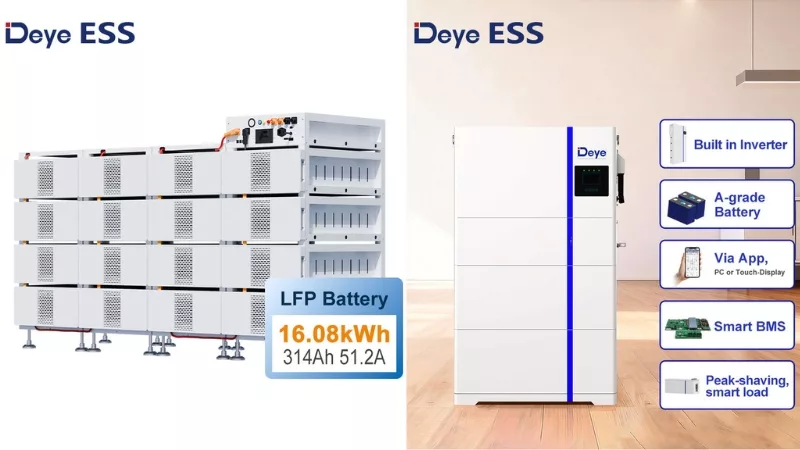
Battery C-rate defines your energy storage’s charging/discharging efficiency and lifespan—and Deye ESS delivers optimized C-rate performance tailored to your needs. Whether for home backup or commercial use, our systems balance fast power delivery and long-term reliability. Explore Deye’s ESS lineup now to find the perfect C-rate matched solution.
Contact us today for a personalized consultation and unlock seamless, efficient energy storage.