Future-Proofing Your Home: Why the Deye Smart Wallbox AC Charger is the Ultimate Solution for EU EV Owners
The European Union’s transition toward sustainable mobility is accelerating rapidly. Guided by the ambitious climate targets of the European Green Deal and the updated Energy Performance of Buildings Directive (EPBD), residential infrastructure is undergoing a massive transformation. For European homeowners, installing an electric vehicle (EV) charger is no longer just a convenience; it is a critical component of a modern, decentralized, and intelligent home energy system.
As battery capacities grow and solar integration becomes the standard for residential energy efficiency, the choice of home charging hardware requires careful consideration.
Here is a comprehensive technical and economic breakdown of why investing in a 22kW smart charger, specifically the Deye Smart Wallbox AC Charger (SUN-EVSE22K01-EU-AC), represents the most logical and future-proof decision for EV owners across the European Union.
The 11kW vs. 22kW Dilemma: Speed and Compatibility
When evaluating charging solutions, understanding the tangible differences in charging speed and vehicle compatibility is essential. On paper, a 22kW charger delivers power twice as fast as an 11kW unit.
- An 11kW wallbox adds approximately 55–65 kilometers of driving range per hour.
- A 22kW wallbox adds approximately 110–130 kilometers of driving range per hour.
- For a vehicle equipped with a 60 kWh battery (such as the VW ID.3), an 11kW wallbox takes about 5.5 hours to reach a full charge.
- Conversely, a 22kW wallbox can fully charge that same 60 kWh battery in just 3 hours.
Think of a 22kW charger as an insurance policy for your next vehicle. Even if your current EV is capped at 11kW, investing in a 22kW unit protects you against rapidly evolving EV battery technologies.
While standard 11kW models can cost up to €1,200, the high-performance 22kW Deye Smart Wallbox is priced at an incredible €562.65 (including VAT). You are securing premium, future-proof 22kW hardware for the exact same price as a basic, entry-level 11kW system.
Maximizing ROI: The Economics of PV Surplus Charging
The most compelling argument for adopting the Deye Smart Wallbox lies in its ability to integrate seamlessly with residential photovoltaic (PV) systems. By utilizing PV surplus charging, homeowners can dramatically reduce the total cost of EV ownership.
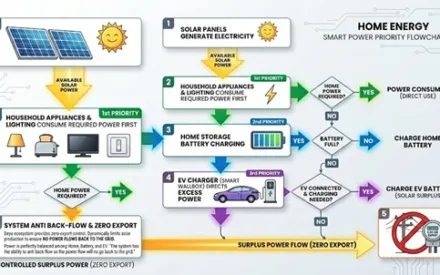
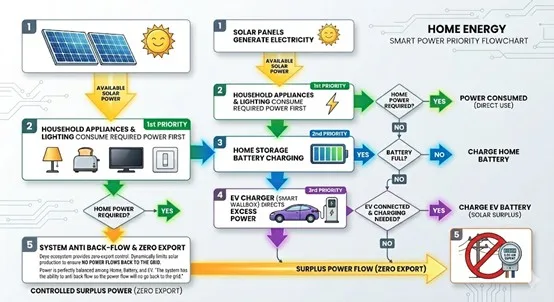
This technology directs excess solar electricity—power generated by your panels that exceeds your home’s immediate consumption—directly into the EV battery instead of exporting it to the local power grid. The energy flow is governed by a strict priority chain:
- Solar panels generate electricity.
- Household appliances and lighting consume the required power first.
- If a home storage battery is installed, it receives the next priority for charging.
- Remaining excess power is then directed to the EV charger.
- A Deye Hybrid Inverter is recommended to realize Solar Energy Only Mode.
The financial savings are substantial. While grid electricity prices vary, assuming an average grid cost of 0.32 EUR per kWh against a self-generated solar cost of merely 0.08 EUR per kWh, the impact on annual driving expenses is profound.
| Charging Source | Cost per kWh | Annual Cost (15,000 km) | Annual Cost (25,000 km) |
| Grid Electricity | 0.32 EUR | 960 EUR | 1,600 EUR |
| PV Surplus (Self-Generated) | 0.08 EUR | 240 EUR | 400 EUR |
| Mixed (50% Grid / 50% PV) | 0.20 EUR | 600 EUR | 1,000 EUR |
Calculations are based on an average EV consumption of 20 kWh per 100 kilometers.
Here is exactly where the 22kW hardware outshines 11kW alternatives. The Deye Smart Wallbox offers an incredibly wide and dynamic adjustment range from 6A up to 32A. During peak summer days, when a solar system produces massive amounts of excess power, an 11kW charger may bottleneck the system. The 22kW Deye unit captures every single watt of surplus energy without wasting potential. Furthermore, it supports automatic phase switching; if solar output drops due to weather, it seamlessly shifts to single-phase operation to maintain charging with as little as 1.4 kW of power.
The Deye Ecosystem: Wireless, Professional, and Secure
The Deye Smart Wallbox is engineered to operate flawlessly within a broader smart home energy ecosystem. Selecting the Deye Smart Wallbox is more than just acquiring a wallbox—it is an investment in the future of smart, sustainable living.
Wireless LoRa Integration
When paired with aDeye Hybrid Inverter, the wallbox communicates usingDeye Smart Transmitter which supports LoRa protocol. This provides a robust wireless range of up to 200 meters (depending on physical obstructions), eliminating the need for complex and expensive communication wiring between the inverter and the charger.
Intelligent Charging Modes
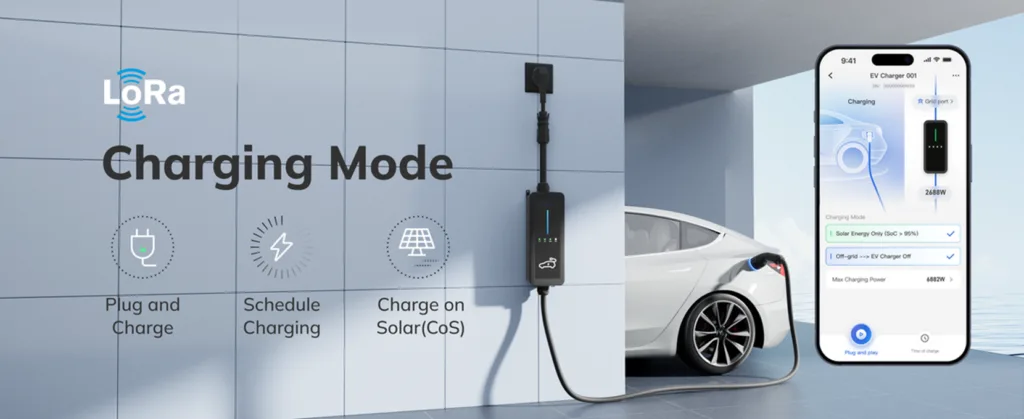
Through theDeye Cloud App, users can perfectly tailor their charging strategy using three distinct modes:
- Plug and Play: Charges the vehicle immediately at the maximum available power, ideal for times when a quick, full charge is needed regardless of the energy source.
- Scheduled Charging: Allows users to set up to four specific charging time slots. This is highly beneficial during the winter months when solar output is low, enabling homeowners to take advantage of cheap off-peak nighttime electricity tariffs.
- Solar Only: Strictly utilizes excess PV energy to achieve the lowest possible charging costs. This mode also respects your home battery’s State of Charge (SOC). By setting an SOC threshold of 95%, the charger will wait until your home battery is almost completely full before it activates, ensuring your household always retains priority backup power.
Here is a quick breakdown of how the Deye Smart Wallbox outperforms a standard non-smart AC charger:
| Feature | Standard AC Charger | Deye Smart Wallbox AC Charger (22kW) |
| Solar Surplus Integration | No (Charges at a fixed rate, often pulling from the grid) | Yes (Dynamically adjusts from 6A to 32A to perfectly match solar output) |
| Cloud/Weather Adaptability | Stops charging or pulls grid power if solar output drops | Automatic Phase Switching: Drops to single-phase (1.4 kW) to keep charging purely on solar during cloudy weather |
| Inverter Communication | Requires complex third-party wiring or external energy managers | Wireless LoRa: Communicates directly with Deye inverters up to 200m away with no extra cables |
| Home Battery Sync | Blind to home storage (may drain your house battery to charge the car) | SOC Threshold Control: Prioritizes your home battery first, only charging the EV when the house battery hits your designated target (e.g., 95%) |
| Charging Modes | “Plug and Charge” or simple timers | Three Intelligent Modes: Plug & Play, Scheduled Charging, and Solar Only |
Robust and Certified Hardware
Built to endure diverse European climates, the Deye Smart Wallbox features an IP66 rating, meaning it is entirely sealed against dust and protected from powerful water jets. It operates reliably in extreme temperatures ranging from -40°C all the way up to +55°C, making it suitable for outdoor installation without an additional protective cover.
Conclusion: A Strategic Investment in Mobility
Installing a smart, future-oriented EV charger is a critical step in maximizing the return on investment of both your electric vehicle and your residential solar infrastructure. By choosing the Deye Smart Wallbox, you are securing premium, high-capacity hardware that offers unparalleled flexibility. It ensures you can capitalize on the fastest possible charging speeds, flawlessly capture every watt of free solar energy, and seamlessly integrate into a wireless smart home ecosystem.
References & Data Sources
Policy & Regulatory Framework
- European Commission: The European Green Deal climate targets.
- European Union: Energy Performance of Buildings Directive (EPBD).
Economic & Technical Assumptions
- Electricity Costs: Calculations are based on an estimated average grid electricity cost of 0.32 EUR per kWh versus a self-generated photovoltaic (PV) cost of 0.08 EUR per kWh.
- Vehicle Consumption: Estimated annual driving costs are calculated based on an average electric vehicle consumption of 20 kWh per 100 kilometers.
- Charging Speeds: Charging time comparisons utilize the 60 kWh battery capacity of the Volkswagen ID.3 as a baseline.
Hardware Specifications
- Deye Smart Wallbox AC Charger (Model: SUN-EVSE22K01-EU-AC).