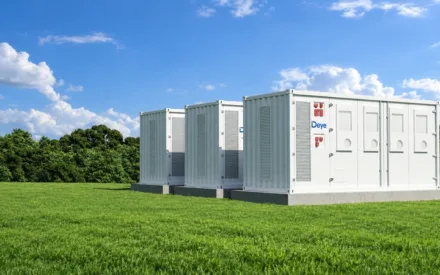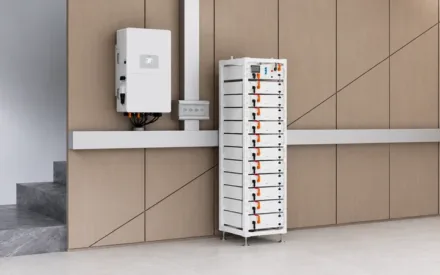
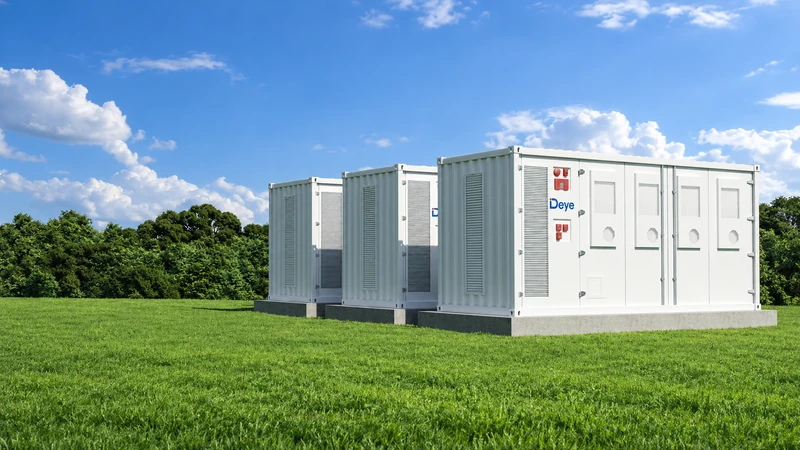
A containerized BESS, or battery energy storage system, stores electricity in battery racks housed in an engineered enclosure. A power conversion system (PCS) manages electricity exchange with the AC network, while battery and site controllers enforce operating limits and schedule charging or discharging. Thermal management and protection equipment support operation within the system’s design conditions.
For developers and engineering, procurement, and construction (EPC) contractors, the container is one part of a complete plant. Grid connection, civil works, controls integration, and commissioning still determine how that plant performs.
What is inside the system
The exact equipment boundary varies. Some solutions integrate batteries, conversion equipment, and controls; others use separate PCS skids, transformers, or switchgear. Check the bill of materials and single-line diagram before comparing quotations.
| Component | Main role | Procurement question |
| Battery cells, modules, and racks | Store energy electrochemically | What usable energy is available under the required conditions? |
| Battery management system (BMS) | Monitors battery conditions and sets operating limits | How are rack faults and limits communicated? |
| PCS | Converts between DC battery power and AC network power | What continuous power and grid functions are included? |
| Energy management system (EMS) | Schedules operation against project objectives | Which meters, devices, and dispatch interfaces are supported? |
| Thermal management | Controls equipment temperature | What cooling power and ambient derating apply? |
| Protection and detection equipment | Detects abnormal conditions and initiates protective actions | What equipment and project documentation are supplied? |
Protection equipment reduces particular risks within its design scope. Its presence does not establish approval for every installation location.
Follow the energy from charging to discharge
Charging
In an AC-coupled arrangement, electricity from the grid or an AC-connected renewable plant passes through the PCS and becomes direct current for battery charging. In a compatible DC-coupled design, photovoltaic (PV) generation can reach the battery through a shared DC architecture and suitable conversion equipment.
Charging power is constrained by battery limits, converter ratings, temperature, available generation or import capacity, and the connection agreement. The controller must also leave space for future charging if the application requires it.
Storage
Energy remains stored chemically until dispatched. The BMS monitors parameters such as voltage and temperature. Cooling, controls, and other auxiliary equipment consume energy, so stored energy and net delivered energy are different quantities.
Discharging
The PCS converts battery DC into AC for the connected network or loads. Discharge ends or reduces when the dispatch request falls, a reserve threshold is reached, or an equipment limit applies. A grid-connected system does not automatically supply loads during an outage: islanded operation requires suitable controls, switching, protection, and a compatible electrical design.
How do BMS, PCS, and EMS controls work together
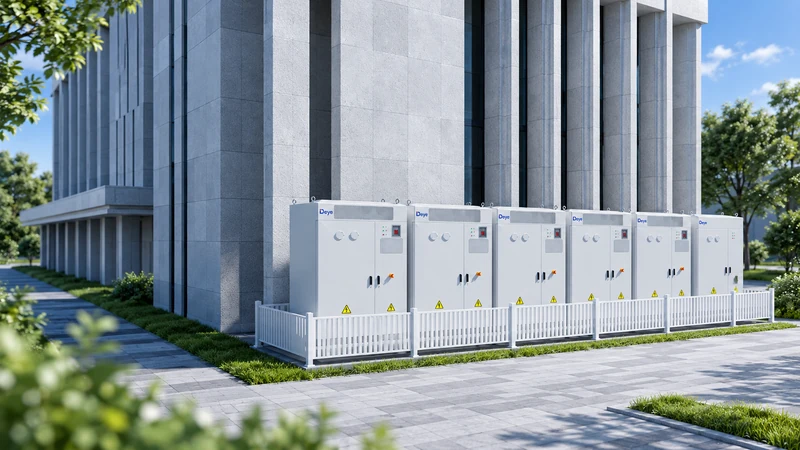
The BMS establishes battery operating limits. The PCS executes allowable power conversion commands. The EMS coordinates the site objective, such as limiting demand, following a dispatch schedule, or increasing renewable self-consumption.
For example, an EMS might request discharge during a facility peak, but the actual output must stay within current battery and PCS limits. Control commissioning should test what happens when metering, communications, or an external dispatch signal becomes unavailable.
The Deye MS-EMS product page lists functions including demand control, load tracking, and SOC balancing. Confirm the controller scope, supported devices, and enabled functions for the proposed project.
Size power and energy separately
Power, measured in kW or MW, describes the rate of delivery. Energy, measured in kWh or MWh, describes the quantity available over time.
For an illustrative preliminary estimate:
Delivery duration = usable energy at the agreed delivery boundary ÷ discharge power at the same boundary.
If 2 MWh is available at the AC delivery point and output is held at 1 MW, the calculated duration is two hours. This assumes constant power and that reserves, conversion losses, and auxiliary consumption have already been reflected in the available energy. Dividing nameplate DC capacity by AC power does not establish a guaranteed runtime.
Ask suppliers to state beginning-of-life and end-of-life energy, ambient conditions, allowable SOC range, auxiliary consumption, and the measurement boundary for any performance guarantee.
What remains to be engineered on site
Review foundation loading, lifting access, drainage, flood exposure, cable routes, earthing, equipment access, and emergency response arrangements. Establish separation and access requirements with qualified local designers and the authority having jurisdiction.
The interconnection scope may include transformers, switchgear, protection coordination, revenue metering, and communications with a utility or plant controller. Define responsibility for each item.
Factory acceptance testing should establish the supplied equipment’s function. Site acceptance testing should verify the installed plant, including metering direction, operating modes, protective responses, and agreed power and energy tests.
Select a configuration around the duty cycle
Start with the Deye utility-scale ESS solution for grid and renewable integration applications. The WS-G(S)2000-2H3 product page describes a containerized utility-scale option. Confirm the current regional configuration and documentation against the project’s duty cycle rather than selecting by enclosure size alone.
To request a proposal, contact Deye ESS with the required MW and MWh, dispatch profile, connection voltage, site conditions, operating modes, location, and delivery schedule. Include expected cycling and any end-of-life performance requirement.
Frequently asked questions
Does containerized mean ready to connect immediately
No. Factory integration can simplify equipment assembly, but civil works, electrical connection, protection, permits, and commissioning remain project responsibilities unless included in the contracted scope.
Can every containerized BESS operate off-grid
No. Off-grid operation requires appropriate inverter capabilities, controls, protection, and load coordination. Confirm black-start, grid-forming, and transition requirements individually where relevant.
Is a larger battery always a better investment
No. Additional energy capacity only creates value when the operating profile can use it. Power constraints, charging opportunities, tariffs, cycling limits, and capital cost can make a smaller configuration more suitable.
Is all the equipment inside one container
Not necessarily. Batteries, PCS, transformers, and switchgear may be distributed across different enclosures. Compare the complete plant scope and connection boundary.