


Battery storage reduces renewable energy curtailment by charging when wind or solar output would otherwise be restricted, then delivering that energy when demand or network conditions allow. Recovery depends on the battery’s location, charging power, available storage capacity, and permission to operate during the constraint. Storage cannot eliminate every cause of curtailment.
For renewable developers and industrial energy users, the key investment question is how much otherwise-lost generation can become useful, saleable electricity after losses and operating costs.
What causes renewable energy curtailment
Curtailment is a deliberate reduction in available generation. A solar or wind plant may be instructed to reduce output because local demand is low, transmission capacity is constrained, or system operating conditions require it. A commercial solar installation may also limit output to comply with an export cap.
Low resource availability, maintenance downtime, and equipment failure are different causes of lost production. Keep them separate in the baseline, because a battery cannot recover electricity that was never available.
Inverter clipping also needs separate treatment. A battery on the AC side generally cannot recover PV energy already lost at an undersized solar inverter. Capturing that energy may require an appropriately designed DC-coupled path with available charging capacity.
How does storage capture otherwise-curtailed energy
The controller identifies surplus generation and directs it into the battery before the site exceeds its operating limit. Later, it schedules discharge when the energy can serve a local load or pass through the permitted export connection.
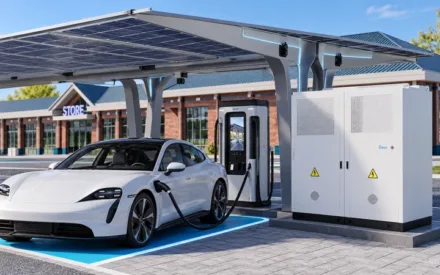
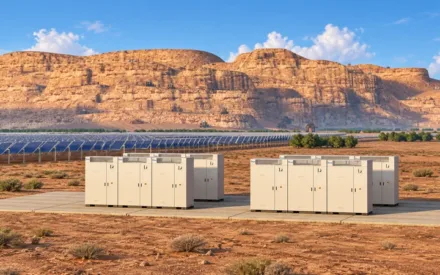
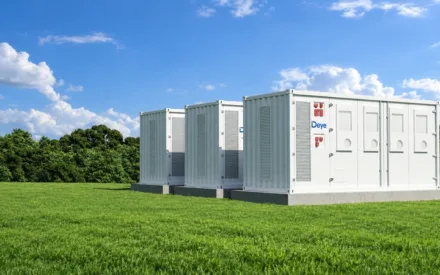
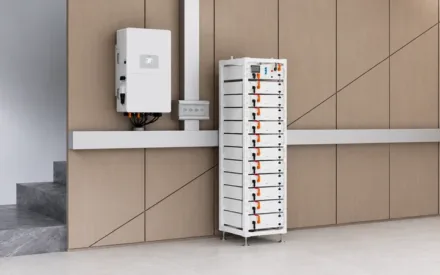
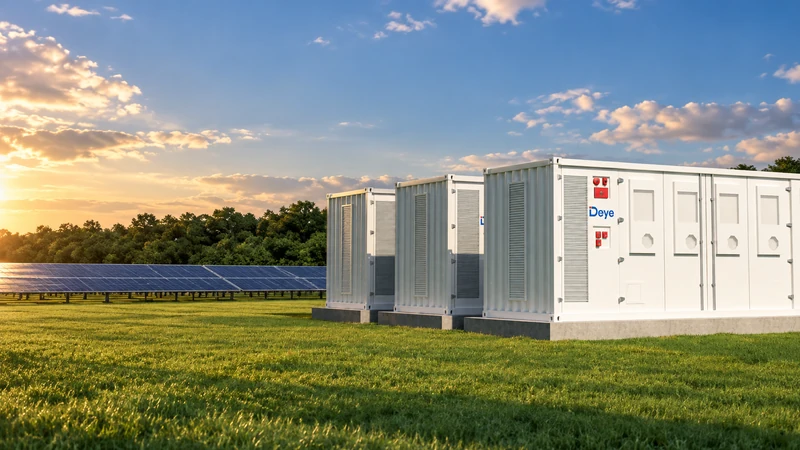
At a commercial site, this can shift midday solar surplus into evening production hours. At a renewable power plant, it can move delivery to a later dispatch interval. The Deye C&I ESS solution and utility-scale ESS solution provide starting points for these different project categories.
The battery must be electrically positioned so that charging actually relieves the constraint. It must also have enough SOC headroom when surplus arrives. A fully charged battery provides no additional energy absorption until it discharges or another source of headroom becomes available.
Estimate recoverable energy using interval data
Use generation, load, export-limit, and dispatch records at a resolution that captures the constraint. Model the plant chronologically so the battery’s state of charge carries forward between intervals.
A preliminary upper bound on charging power from otherwise-curtailed generation is the minimum of:
- Otherwise-curtailed power available at the charging connection.
- Available charging capability after equipment and operating limits.
- Power permitted by the electrical connection and control rules.
The energy accepted over an interval is also limited by available storage headroom, with conversion losses applied at a defined boundary. Repeat the calculation over the full study period rather than resetting the battery to empty for every event.
Illustrative example
Assume a plant would otherwise curtail a constant 1 MW for three hours. The available curtailed energy is 3 MWh. If a battery can accept only 0.5 MW, it can absorb at most 1.5 MWh during that event, even if its energy capacity is larger.
If it instead has only 1 MWh of available input-energy headroom, absorption is limited to 1 MWh. Assuming an illustrative 90% input-to-output efficiency over the defined cycle boundary, that captured energy would deliver approximately 0.9 MWh. These are calculation assumptions, not Deye product specifications or a project forecast.
When does a battery fail to solve the constraint
| Constraint | Why storage may be insufficient | Design response |
| Repeated surplus with little discharge opportunity | The battery remains full | Model consecutive days and alternative dispatch windows |
| Short, high-power surplus | Charging power is too low | Compare additional converter power with recoverable value |
| Network restriction persists into discharge hours | Stored energy cannot be exported later | Test local use and realistic release of the constraint |
| Battery is beyond the relevant bottleneck | Charging does not relieve congestion | Study placement and network flows |
| Operating instruction restricts battery charging | The intended dispatch is not permitted | Confirm connection and dispatch rules before procurement |
Demand flexibility, network reinforcement, and generation control changes may complement storage. Compare them using the same baseline and operating assumptions.
Measure useful recovery and commercial value
Track curtailed MWh, captured MWh, net delivered MWh, and changes in export or grid imports. Separate battery input from delivered output so losses are visible.
For the financial model, value recovered energy at the time it is delivered or used. Deduct auxiliary energy, degradation allowance, maintenance, and relevant fees. Check whether curtailment compensation or power purchase agreement terms change the value of storage charging.
Avoid counting the same battery capacity twice. A system reserved for backup or committed to another service may have less headroom available for renewable recovery. The dispatch model should reconcile these competing uses.
For controller evaluation, the Deye MS-EMS page lists load tracking and anti-backflow among its functions. Confirm the complete metering and plant-control scope needed to respect the site’s export limit.
Request a curtailment-focused storage study
Contact Deye ESS with interval generation and load data, curtailment records, the single-line diagram, export restrictions, tariff or offtake terms, location, and target commissioning date. Ask for a chronological dispatch study that reports recovered energy, losses, residual curtailment, and the assumptions behind the proposed MW/MWh configuration.
Frequently asked questions
Can battery storage eliminate renewable energy curtailment
Not in every project. Energy capacity, charging power, prolonged congestion, dispatch rules, and limited discharge opportunities can leave residual curtailment even after storage is installed.
Is capturing more energy always more profitable
No. The value of additional delivered electricity must justify the extra equipment, losses, cycling, and operating cost. Some low-value surplus may remain uneconomic to capture.
Should a battery be empty before every solar peak
It needs sufficient charging headroom, but the appropriate SOC depends on forecasts, reserve requirements, other commitments, and the battery’s permitted operating window. An empty-battery target is not universally appropriate.
Does AC coupling recover all solar clipping losses
No. Energy clipped before reaching the AC network is generally unavailable to an AC-coupled battery. Recovery requires assessment of the actual PV and storage architecture.