
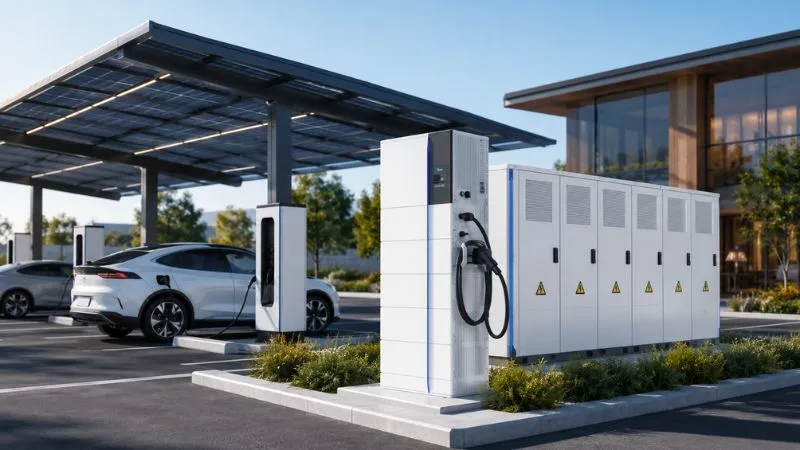
The electric vehicle (EV) market is growing faster than ever. As more drivers make the switch, the demand for fast, convenient charging is going through the roof. But there is a hidden bottleneck threatening to slow things down: our electrical grid.
High-power EV charging stations, especially Level 3 DC fast chargers, require massive amounts of electricity in short bursts. Most local power grids simply weren’t built to handle this kind of sudden, heavy load.
For businesses installing these chargers, this leads to two major headaches: skyrocketing utility bills and wildly expensive grid upgrades.
This is exactly where Battery Energy Storage Systems (BESS) step in to save the day. For bulk distributors, offering battery storage alongside EV charging hardware isn’t just a nice add-on—it is quickly becoming a mandatory part of the package. Let’s break down exactly how battery storage supports high-power EV charging.
The Big Problem with Fast Charging
To understand the solution, we first need to look at the problem.
Imagine a highway rest stop that installs four new DC fast chargers. When four EVs pull up and plug in at the exact same time, those chargers demand a massive spike of electricity from the grid all at once.
Utility companies penalize businesses for these sudden spikes using something called demand charges. Demand charges are fees based on the highest amount of power a business draws during a specific period. For EV charging station operators, these fees can sometimes make up more than 50% of their monthly electricity bill, completely wiping out their profit margins.
If the local grid cannot safely deliver that much power, the utility company will require a grid upgrade before the charging station can even open. This means tearing up roads to install thicker cables and larger transformers. These upgrades can cost hundreds of thousands of dollars and take months, or even years, to complete.
How Battery Storage Fixes the Grid Problem
A battery storage system acts as a buffer between the local power grid and the EV chargers.
Think of the grid like a small water pipe, the EV charger like a massive fire hose, and the battery as a large water tank. The small pipe (the grid) slowly and steadily fills the tank (the battery) all day long. When a car pulls up and needs a huge blast of power, the charger draws it directly from the tank, not the small pipe.
Here are the direct ways battery storage supports EV charging stations:
1. Peak Shaving (Cutting Demand Charges)
This is the biggest financial benefit. When multiple cars plug in and power demand spikes, the BESS kicks in to provide the extra electricity. Because the power is coming from the battery rather than the grid, the utility company never sees the power spike. This strategy is called “peak shaving,” and it drastically lowers those expensive monthly demand charges, keeping the charging station profitable.
2. Avoiding Expensive Grid Upgrades
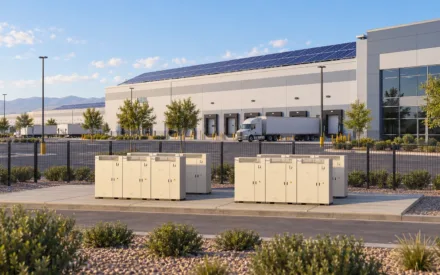
Instead of paying the utility company a fortune to upgrade local power lines, a business can simply install a commercial battery system. The BESS allows high-power fast chargers to operate perfectly on standard, lower-capacity grid connections. It is a faster, cheaper, and much more predictable investment.
3. Making the Most of Solar Energy
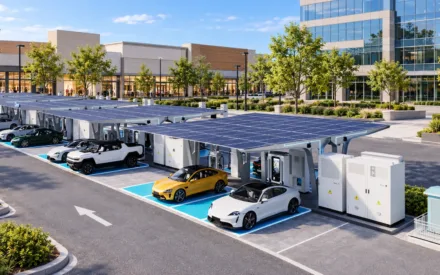
Many new charging stations are installing solar panels on their canopies. However, solar panels only generate power when the sun is shining, which might not be when drivers are actually charging their cars. A BESS captures and stores that free solar energy during the day so it can be used to charge cars at night or during cloudy weather.
4. Keeping Chargers Online During Outages
Reliability is everything in the EV charging business. If the grid goes down, a charging station without a battery is out of luck—and drivers are stranded. Battery storage provides essential backup power, allowing the station to keep selling electricity and serving customers even during a blackout.
Why This Matters for Distributors
If you are distributing EV chargers, solar equipment, or electrical infrastructure, battery storage is the missing piece of the puzzle.
Your customers—charging network operators, fleet managers, and commercial real estate developers—are actively looking for ways to make fast charging economically viable. Selling them an EV charger without a battery is like selling a high-performance car without a fuel pump; it just won’t run efficiently.
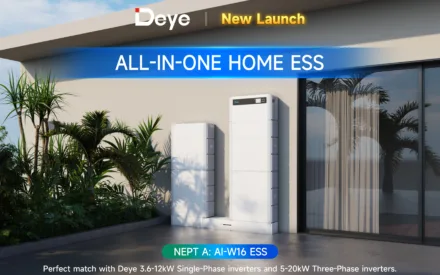
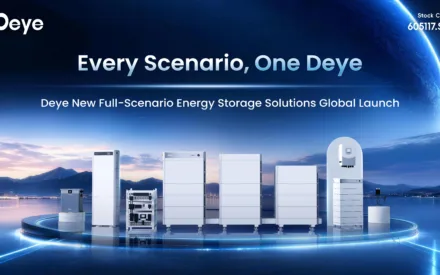
By offering Deye ESS battery storage solutions, you position your business as a comprehensive solution provider rather than just a parts supplier.
Here is why BESS should be a core part of your bulk distribution strategy:
- Higher Deal Values: Bundling commercial BESS units with EV chargers significantly increases your average order value.
- Solving Real Pain Points: You aren’t just selling hardware; you are selling a direct solution to utility demand charges and grid delays. Your customers will see a clear, measurable Return on Investment (ROI).
- Future-Proofing: As grids get more crowded and electricity prices change, the demand for local energy storage is only going to increase. Getting in now secures your place in a rapidly growing market.
Partnering with Deye ESS for Your Distribution Needs
At Deye ESS, we understand the unique demands of the B2B market. Distributors need hardware that is easy to install, incredibly reliable, and scalable to fit different project sizes.
Whether your clients are building a massive highway charging hub or adding a few fast chargers to a retail parking lot, they need energy storage that performs safely under heavy daily use. We design our commercial battery storage systems specifically to handle the intense cycle demands of EV fast charging, ensuring long-term profitability for the station operators.
The future of transportation is electric, but it relies entirely on smart, localized energy storage. By adding high-quality BESS to your distribution lineup, you can help your clients overcome grid limitations and build a better, faster charging network.