


If you are setting up a commercial or industrial Battery Energy Storage System (BESS), you already know that the batteries are only half the story. The other half is how your equipment talks to each other.
For your battery management system (BMS), inverters, and central controllers to work together safely and efficiently, they need a reliable language. In the world of energy storage, the two most popular languages—or communication protocols—are CAN and RS485.
But what exactly are they, and how do you know which one is right for your project? Let’s break it down in simple terms.
Why Communication Protocols Matter
Think of a commercial battery storage system like a busy warehouse. The batteries are the workers, the inverter is the manager, and the BMS is the safety inspector. If they can’t communicate instantly and clearly, things can go wrong fast. You might overcharge a battery, lose power during a critical moment, or fail to spot a temperature spike.
Communication protocols are the wired networks that let these components share data—like voltage levels, temperature, and charge status—in real-time.
What is CAN Bus?
CAN stands for Controller Area Network. It was originally built for the automotive industry to help the different parts of a car talk to each other without a central computer. Today, it is highly popular in battery storage.
How it works: CAN uses a “multi-master” system. Think of it like a round-table meeting where everyone is an equal. Any device on the network can speak up and send data whenever it needs to. If two devices try to talk at the exact same time, the CAN system automatically prioritizes the most urgent message (like a safety alert).
The Pros of CAN:
- High Speed: It transfers data very quickly, which is critical for real-time safety checks.
- Highly Reliable: It has built-in error checking. If a message gets scrambled, the system catches it and sends it again.
- Smart Priority: Critical alerts (like a battery overheating) will always jump to the front of the line.
The Cons of CAN:
- Shorter Distance: CAN is built for speed, not distance. It works best when your devices are relatively close to each other (usually under 40 meters for high speeds).
- More Complex: It can be slightly more expensive and complex to program than older systems.
What is RS485?
RS485 is a tried-and-true standard that has been used in industrial automation for decades. It is simple, rugged, and gets the job done.
How it works: Unlike the round-table style of CAN, RS485 usually operates on a “master-slave” setup. Think of it like a classroom. The central controller (the teacher) asks a specific battery module (the student) for its status. The battery only speaks when spoken to.
The Pros of RS485:
- Long Distance Runner: RS485 is incredibly resilient over long cable runs. It can reliably send data over distances up to 1,200 meters.
- Simple and Cost-Effective: It is cheap to implement, easy to wire, and very easy to troubleshoot if something goes wrong.
- Handles Lots of Devices: You can easily connect dozens of battery modules in a simple “daisy chain” line on a single network.
The Cons of RS485:
- Slower Speeds: Because devices have to wait their turn to speak, data transfer isn’t as instant as CAN.
- Single Point of Failure: If the “master” controller goes offline, the whole communication chain stops until it is fixed.
Head-to-Head: Which One Wins?
There is no single “better” option—it all comes down to what your specific energy storage project needs. Let’s look at how they compare in the real world:
1. Speed vs. Distance
If you need lightning-fast reactions—like a BMS telling an inverter to shut down instantly to prevent damage—CAN is the clear winner. However, if you are building a massive solar farm and need to monitor batteries that are hundreds of meters away from your control room, RS485 is exactly what you need.
2. Wiring and Setup
RS485 is as straightforward as it gets. You wire your devices in a single line, making it highly cost-effective for large B2B installations with dozens of battery racks. CAN requires a bit more careful planning with its wiring network, but it pays off with smarter, automated data traffic.
3. Application
In most modern B2B storage systems, you will actually see both used at the same time:
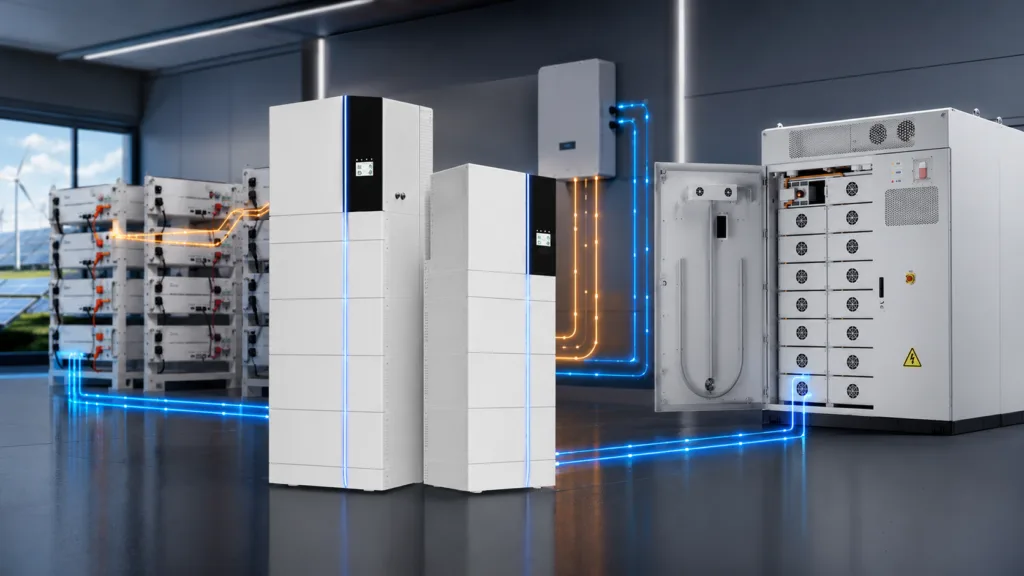
- CAN is typically used for the “internal” conversation. It connects the battery packs to the main BMS, and the BMS to the inverter.
- RS485 is often used for the “external” conversation. It connects the entire storage system to an external computer, a building management system, or a data logger for long-term monitoring.
Making the Right Choice for Your Business
When planning your next commercial battery storage project, you don’t necessarily have to choose one over the other. The best BESS manufacturers design their equipment to support both protocols.
Here is a simple rule of thumb:
- Rely on CAN when safety, speed, and real-time inverter integration are your top priorities.
- Rely on RS485 when you need to network many devices over a large facility, or when you are setting up simple, long-term data monitoring.
At deyeess.com, we understand that B2B energy storage needs to be both powerful and reliable. Choosing the right communication setup ensures your investment runs safely and efficiently for years to come.
Need help designing the perfect battery storage architecture for your commercial project? Reach out to our team today to discuss the best setup for your facility.