

Lithium battery temperature affects how much power a battery can deliver, how quickly it can charge, how efficiently it operates and how fast it ages. Cold conditions can temporarily reduce available capacity and charging power. High temperatures may improve short-term reaction rates, but they accelerate degradation and can increase safety risk.
For a home or commercial energy storage system, this means location and thermal management are part of system design. A battery should not be selected by capacity alone. Its specified charging, discharging and storage temperature ranges must also fit the site.
This article explains what changes inside the battery and what owners can do to support reliable operation.
Why Temperature Changes Battery Behavior
Lithium batteries move lithium ions between electrodes through an electrolyte. Temperature affects the speed of those electrochemical reactions and the resistance inside the cells.
In cold conditions, ion movement slows and internal resistance rises. Voltage can drop more under load, so the battery management system may reduce output or report less usable energy. Charging is more sensitive because forcing charge into a cell at a low temperature can create damaging conditions.
In hot conditions, reactions happen faster and resistance may be lower in the short term. The problem is that unwanted side reactions also accelerate. Over time, these reactions consume active material, increase resistance and reduce capacity. Heat generated by high-power operation can add to a hot environment, which makes cooling and system limits important.
What Cold Weather Does to a Lithium Battery
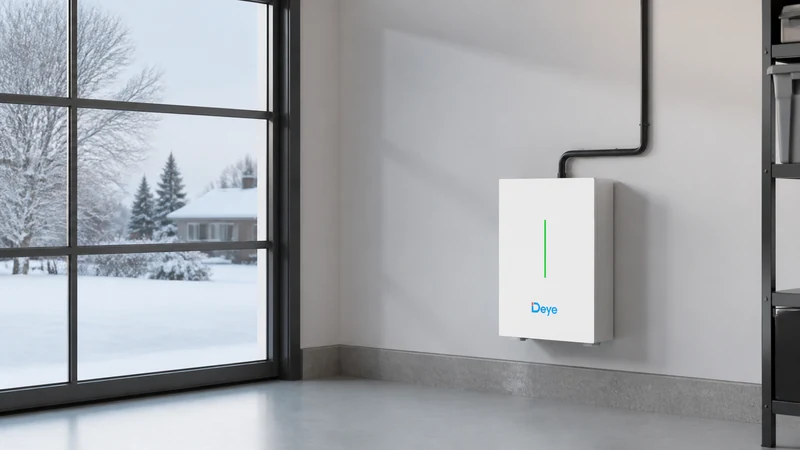
Cold-related performance loss is often temporary. When the battery returns to a moderate operating temperature, part of the lost capability returns. While it is cold, however, users may notice:
- Less available energy than expected.
- Lower charge or discharge power.
- Greater voltage drop when a large load starts.
- Longer charging time.
- Protective limits or a temporary shutdown from the BMS.
Charging deserves special attention. Many lithium iron phosphate (LFP) energy storage batteries have a higher minimum temperature for charging than for discharging. A product may be able to supply power below 0°C but not accept a normal charge at the same temperature. Some systems include a heating function that warms the cells before charging.
For example, the Deye RW-F10.2-B residential battery specifies a charging range starting at 1°C and a discharging range starting at -20°C. Product limits vary, so always use the datasheet and manual for the exact model.
What High Temperature Does to Performance and Life
A hot battery may appear to perform normally at first, but long exposure to heat speeds up calendar aging—the capacity loss that occurs with time even when the battery is not cycling. Heat can also increase the effect of spending long periods at a high state of charge.
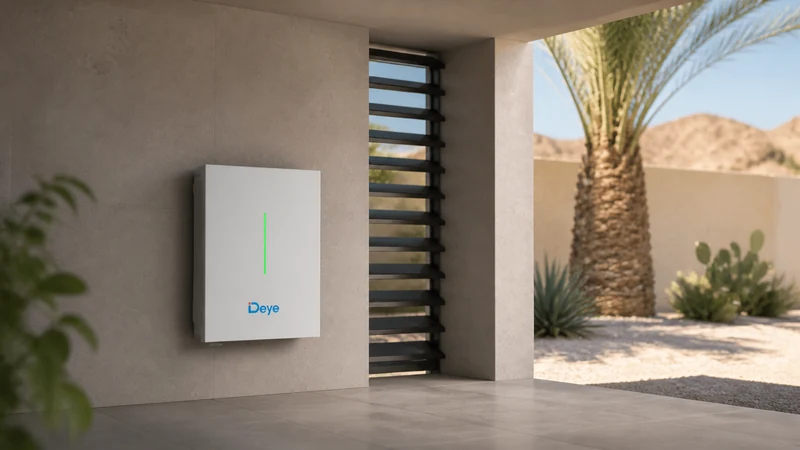
Possible results include:
- Faster loss of usable capacity.
- Higher internal resistance as the battery ages.
- More frequent power derating.
- Increased cooling energy in a commercial system.
- Shorter service life if high temperature is persistent.
Very high temperature or a thermal fault can become a safety issue. Modern energy storage systems use a battery management system to monitor cell voltage, current and temperature. It can reduce current or stop operation when conditions move beyond safe limits. This protection is essential, but it should not be treated as a substitute for a suitable installation environment.
Operating Range Is Not the Same as the Best Operating Temperature
A common mistake is to read an operating range as the ideal range. If a battery is rated to discharge from -20°C to 55°C, that means operation may be permitted within those boundaries under specified conditions. It does not mean performance and aging are identical at every temperature.
Datasheets often publish cycle-life tests at around 25°C. The Deye SE-F16 home battery, for instance, lists its cycle-life test at 25°C ±2°C while also giving broader operating ranges for charging and discharging. The distinction matters when comparing published performance with a hot outdoor installation or an unheated winter location.
Current limits may also change with temperature and state of charge. The battery management system can derate charge or discharge power to protect the cells. A designer should therefore check the power available at the site’s expected temperature extremes, not only the maximum current in the headline specification.
How to Protect an Energy Storage Battery from Temperature Extremes
Choose the Location Carefully
Use a dry, well-ventilated location within the product’s environmental limits. Avoid direct sunlight, nearby heat sources and enclosed spaces that trap heat. Also consider the coldest overnight temperature, not only the daytime average.
Match the Enclosure to the Site
An IP rating describes protection from solid objects and water under defined tests. It does not automatically provide temperature control. An outdoor-rated cabinet may still need shade, heating or active cooling depending on the climate and system design.
Use Built-In Monitoring
Review temperature readings, warnings and power limits in the approved monitoring platform. Repeated high- or low-temperature alarms usually point to a location, airflow, loading or equipment issue that should be investigated by a qualified technician.
Size for Real Conditions
If the site is frequently cold or hot, account for reduced power and energy rather than assuming room-temperature output. A larger battery does not fix every thermal issue, but realistic derating can prevent an underperforming design.
For larger projects, the Deye C&I ESS solution includes systems with coordinated battery, controls and thermal-management functions for commercial operating profiles.
Questions to Ask the Supplier or Installer
Before choosing a battery, ask:
- What are the permitted charging, discharging and storage temperature ranges?
- Is there a recommended temperature range for best performance?
- How does charge and discharge power derate in heat or cold?
- Does the model include heating or active cooling?
- Where are the temperature sensors located, and what does the BMS control?
- Is the proposed indoor or outdoor location approved?
- How might local conditions affect warranty requirements?
Treat Temperature as a Design Input
Cold can temporarily reduce lithium battery energy and power, while heat can speed long-term degradation. The best protection is to select a suitable product, install it in an approved location and let the BMS and thermal controls operate within a well-designed system.
Need an ESS that fits your local climate and duty cycle? Visit the Deye ESS Contact page and fill in the inquiry form. Include your country, minimum and maximum site temperatures, indoor or outdoor location, required capacity, peak load and expected operating schedule. This will give the team the practical information needed to discuss an appropriate battery and system configuration.