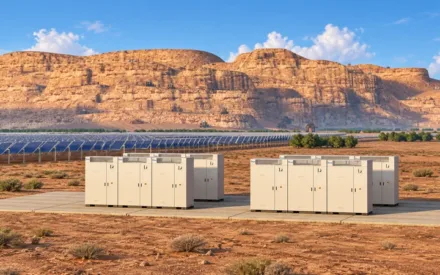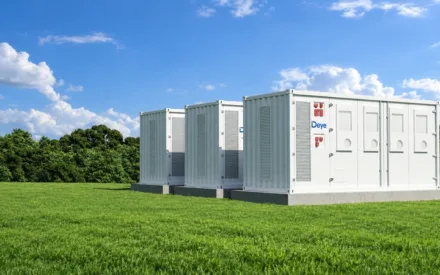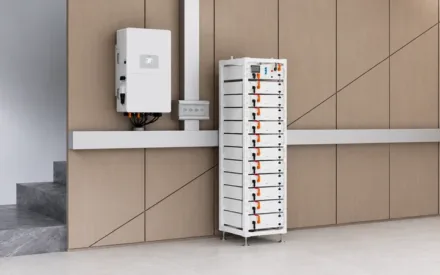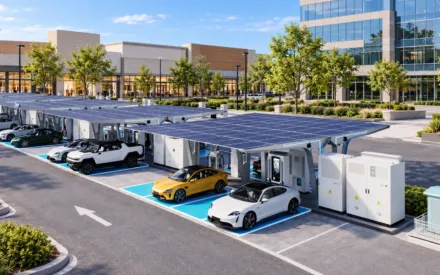

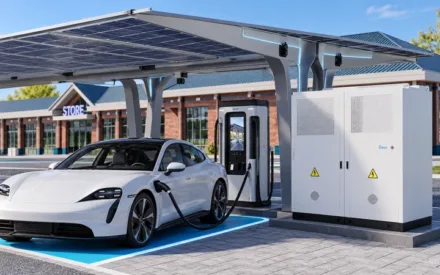

Battery-buffered EV charging uses a stationary battery to supplement the site’s electricity supply during charging peaks. The battery charges when spare grid capacity or solar generation is available, then discharges when vehicles need more power than the site can draw directly. This can support selected charging demand within a constrained connection, provided the battery has sufficient power, energy, and time to recharge.
For charging operators, fleet depots, and commercial property owners, the design challenge is balancing short peaks with sustained energy demand. A battery can shift electricity over time, but it cannot make up a permanent daily energy shortfall.
How does the charging system work
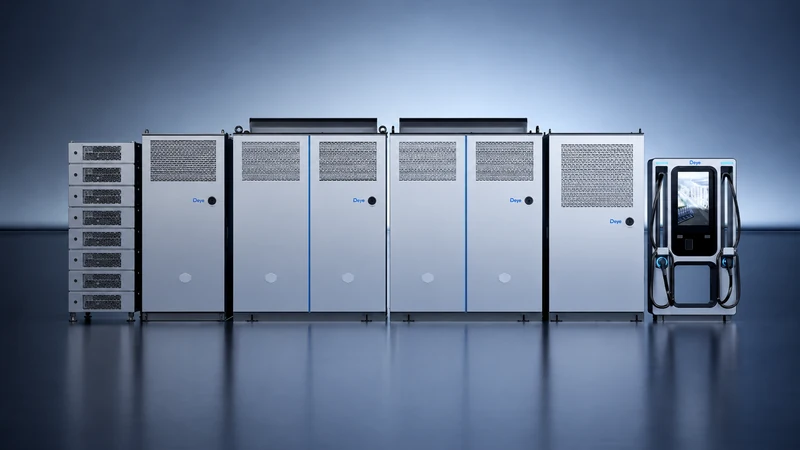
A typical installation combines EV chargers, a stationary battery, conversion equipment, metering, and an energy management system (EMS). Photovoltaic (PV) generation may contribute additional energy.
The EMS observes the site’s net demand and adjusts battery dispatch or charger power to respect the connection limit. During a busy period, grid power and battery output can supply charging together. Between sessions, available capacity recharges the battery without creating a new import peak.
Actual power paths depend on the architecture. Some systems combine equipment on an AC bus; others use a compatible DC arrangement. Confirm whether quoted charger power is measured at the vehicle output, charger input, or another electrical boundary.
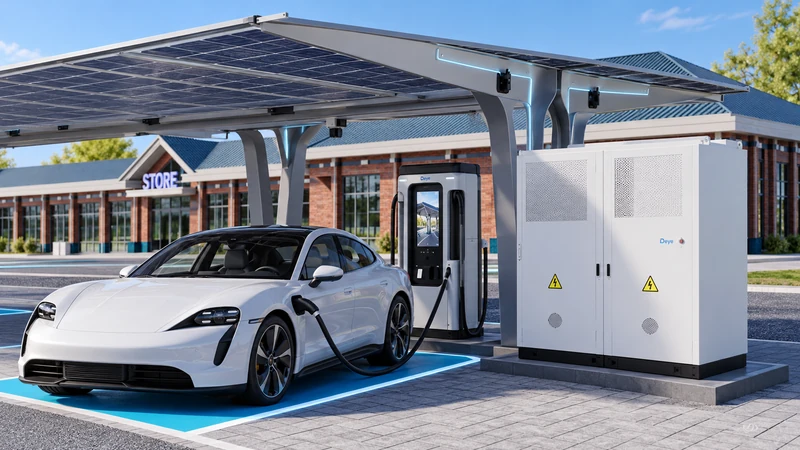
The Deye PV-BESS-EV charging solution presents an integrated approach to generation, storage, charging, and management. Each site still requires a defined connection and control design.
Size the power deficit before sizing energy
Begin with the maximum charging load the site is intended to support, then include building demand, auxiliaries, and losses at a consistent boundary.
For an illustrative AC-bus calculation:
Required battery output = charger input demand + other site demand − available grid supply − usable PV output.
When the result is negative, there is no battery discharge requirement for that interval. PV should be represented by realistic time-series output, especially where charging performance must be maintained through cloud cover or at night.
Example supporting a 30-minute peak
Assume charger AC inputs total 300 kW, other site loads are 20 kW, the permitted grid import is 150 kW, and PV contribution is zero. The battery must supply 170 kW at the AC bus.
For 30 minutes at that constant deficit, the required delivered energy is:
170 kW × 0.5 hours = 85 kWh.
If the assumed battery-to-AC efficiency is 95%, approximately 89.5 kWh must be withdrawn at the battery-side boundary. Nameplate capacity must additionally account for the usable SOC window, reserve, temperature, and degradation. These figures illustrate sizing logic and do not describe a Deye product configuration.
Check recharge time and consecutive sessions
Passing one peak event does not establish all-day service capability. Model the sequence of vehicle arrivals, departure deadlines, vehicle charging curves, and battery SOC.
If only 50 kW of spare AC supply remains after other loads, replacing 85 kWh of delivered energy takes more than 1.7 hours once round-trip losses are included. A second large charging event before recovery may require charger power reduction.
The long-term energy balance also has to close. Over a repeatable daily cycle, grid and PV energy must cover vehicle charging, other site loads, and storage losses while restoring the planned battery SOC. Otherwise, a grid upgrade, more generation, lower charging throughput, or a different operating schedule is needed.
Where does battery buffering make commercial sense
| Operating pattern | Potential role for storage | Main limitation to test |
| Intermittent public fast-charging peaks | Support short periods above the available supply | Back-to-back sessions and reserve depletion |
| Depot with concentrated return times | Spread grid draw across the operating window | Departure deadlines and total daily energy |
| Solar-equipped commercial parking | Shift surplus generation into later charging | Seasonal PV output and vehicle dwell time |
| Site exposed to demand charges | Limit measured import peaks where tariffs reward it | Demand intervals, ratchets, and recharge scheduling |
Compare battery buffering with managed charging and utility connection upgrades. Where vehicles remain parked for hours, slower coordinated charging may satisfy the service requirement with less storage.
What should the controls and contract specify
Define the import limit at the point of common coupling and allocate capacity between building loads, chargers, and battery charging. Specify charger throttling behavior when battery SOC reaches its operating reserve.
Agree on the response to lost communications, meter failure, and unavailable equipment. Commissioning should test these situations as well as normal operation. Retain enough monitoring data to distinguish charger availability, battery performance, and grid constraints.
A battery-supported charging site is not automatically an outage charging service. Backup operation requires suitable islanding equipment, compatible controls, protection, and an explicit critical-load design.
For equipment review, the MC-LC430-2H2 Series is presented as a Deye C&I PV-BESS-EV integrated solution for Europe and Australia. Confirm the current regional configuration, included charger equipment, and supported operating modes against project documents.
Build an RFQ around charging service
Contact Deye ESS with the site connection limit, interval building loads, charger quantities and ratings, vehicle arrival patterns, required energy per session, PV details, tariff, location, and timeline. Request a dispatch simulation showing charging service, battery recovery, and behavior when storage is unavailable.
Frequently asked questions
Can a small grid connection support fast charging through a battery
Potentially, for a defined load profile. The battery must cover the power deficit and have enough stored energy. Sustained throughput remains constrained by recharge opportunities and total available energy.
Does battery buffering always avoid a grid upgrade
No. It may defer or reduce an upgrade for some sites, but high utilization or insufficient recharge capacity can still require more grid supply.
Do I need solar for battery-buffered charging
No. A compatible system can charge from the grid during spare-capacity periods. Solar may contribute energy, but its output and commercial value must be assessed separately.
Will storage guarantee lower demand charges
No. Savings depend on the tariff, measured demand intervals, operating reliability, and battery dispatch. Uncontrolled recharge can create another peak.